Melissa Sánchez Herrera y yo estamos organizando un simposio de la Sección Sys-EB para el EntSoc 2019 reunión en St. Louis, MO.
El simposio se titula:
Errores en tecnicolor: cómo la investigación del color aboga por la entomología
El reflejo y la emisión de luz de las superficies de los insectos ha fascinado e inspirado a los entomólogos y al público en general durante siglos. El objetivo de nuestro simposio es proporcionar un entorno en el que debatir la investigación del color y su uso en iniciativas de divulgación pública que tienen como objetivo inspirar la curiosidad de los insectos y defender la entomología. Tenemos charlas que serán impartidas por entomólogos de diferentes continentes / países que trabajan en proyectos diversos e ingeniosos que incorporan componentes de coloración de insectos que incluyen producción, estructuras, percepción y selección.
Además de estas charlas, tenemos la intención de tener un exhibición electrónica de imágenes, ilustraciones y videos que cumplan con estos criterios y, por lo tanto, estamos buscando presentaciones para este esfuerzo.
Si está interesado en incluir una imagen, complete el formulario a continuación y cargue su imagen / video.

DR. AMANDA WHISPELL
ILUSTRACIONES Y DISEÑO GRÁFICO

Insect Conservation
Adults
1–1.5 hours
PowerPoint
This lecture covers the current conservation status of insects and includes:
- Insect evolution
- Ecosystem services provided by insects
- Current threats to insects
- Summary of recent research that has documented major reductions in insects
- What we need to do to help conserve insects and what happens if we don't
- What you can do at your home or in your community to help conserve insects

Entomology for beginners
Adults
3 hours or three 1 hour sessions
PowerPoint
This is an extensive three-hour lecture that covers the basics of entomology. The lecture includes:
- Insect evolution
- The role of insects in science
- Overall insect anatomy and physiology
- The function of the exoskeleton and how / why they molt
- Different types of wings and how they fly
- Sensory systems - including mechanoreception, chemoreception, and photoreception
- Reproduction and development
- An overview of some of the orders we have in Virginia
- Ecosystem services provided by insects
- Current threats to insects and the major reductions we have seen in recent years
- What we need to do to help conserve insects
- What you can do at your home or in your community to help conserve insects
Aquatic Macroinvertebrates
Adults
1 hour
PowerPoint
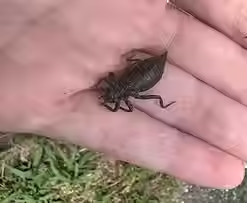
In this course we discuss the diversity of insects that we can use to assess water quality here in the Williamsburg, Virginia, area. We learn how to perform surveys, metrics that can be used for calculations, and pollution tolerance of common species.
This course does not have a workshop/field component at this time, as there has not been any expressed interest as of yet, but if that would be of interest to you, please let us know!

Aquatic Macroinvertebrates - Dry Lab
3rd–5th grade
1 hour
Interactive
In this course we will give your students the opportunity to sample macroinvertebrates, identify them and categorize them based on their tolerance to pullution, and them use them to calculate metrics and assess water quality -- all in the classroom! We have faux environments in which the students must search for small insect models, which are hidden in the soil, in plants, under rocks/logs, etc. All included insect orders/families are specific to our District here in Virginia.
The activity is an excellent opportunity for students to experience this type of field sampling without leaving the school and without making any sort of mess.
The activity would work best if there is a full hour available, but can be done in 45 minutes. Previous students have expressed their love for the activity and that they learned so much!
Beneficial Insects
Adults
1–2 hours
Lecture without PowerPoint (ppt under development)
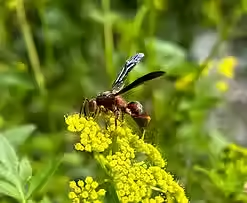
Insects are more than just bugs in the garden—they’re essential workers that pollinate, recycle nutrients, and keep pests in check. In this workshop, Amanda will uncover the hidden world of insects as she discusses their life cycles, diets, and the essential ecosystem services they provide in your garden. You’ll learn simple ways to attract and support pollinators and other beneficial insects, what garden practices to avoid, and the most eco-friendly options for dealing with problem pests when they show up.

Dragonflies and damselflies
Adults
1–1.5 hours
PowerPoint
In this course we will discuss how to identify the major Odonata families we have represented here in Virginia. The primary focus of the course is on adults, but could be adapted to include nymph identification is that is of interest to you. I will also teach you about their evolution, anatomy, how to differentiate between dragonflies and damselflies, their weird and wonderful life histories (including some very unique individuals), and why they are important to the ecosystem.

Get in Touch
Reach out to me via email to discuss my services.